
Ingo’s Warnings and His Encounters
The Hidden World
In a letter dated May 1973, now preserved in his archives at the University of West Georgia, Ingo raised two stark concerns that had emerged from his early perceptual research and his observations of the world around him:
- That money and power were being directed, guided by “invisible benefactors” whose motives, he believed, were deeply questionable and aimed at shaping global economic systems while concentrating power beyond public scrutiny.
- That humanity was not alone on this planet, and that some form of nonhuman intelligence was interacting with us, largely outside public awareness.
Ingo never treated these subjects casually. The letter hints at two sets of actors:
(a) Non-human Entities / Non-human Intelligences (NHE/NHI) operating through unknown mechanisms, and
(b) Human Collaborators he believed were in contact with them, some wittingly, some unwittingly, and some, in his view, dangerously aligned with them.
The 1992 FATE Article: A Direct Statement
In a 1992 FATE Magazine article, Ingo described these entities without metaphor. He called their interactions with humans a form of: body-mind-spiritual rape.
He warned that humanity functions as a resource to them, and that our psychic faculties (especially perception and telepathy) may have been deliberately suppressed because they represent a form of defense.
This article, later reprinted in eight martinis (Issue 18), is one of his clearest statements about the nature of these beings and humanity’s vulnerability.
Penetration (1998): Telepathy Plus and Psychic Interference
In Penetration, Ingo recounted being recruited by a covert group led by a man he called Mr. Axelrod, accompanied by the enigmatic “twins.” He described encounters with nonhuman intelligences and emphasized one central message:
These entities possess a type of telepathy beyond anything humans conventionally understand, what he called Telepathy Plus. This form of telepathy, he said, was not just communication but mind-scrambling, a capacity to manipulate thought and perception.
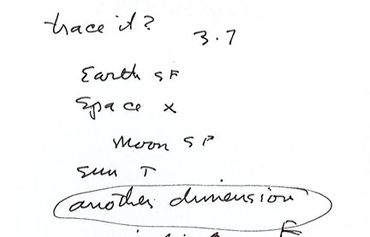
Shortly after publishing the book, Ingo began experiencing severe headaches and sudden, localized pains. Believing them to be psychic attacks, he attempted to identify the source. In his notes (now held in the UWG archives) he recorded a process of systematic questioning: Earth? No. Space? No. The Moon? The Sun? No. Eventually he circled: another dimension.
Despite developing methods to defend himself, the attacks continued intermittently for the rest of his life.
Earlier Encounters: A Doorway Opened
Ingo hinted that these experiences did not begin in the 1990s, that something may have been opened earlier, through an event, an experiment, or an act of cooperation whose consequences he only understood later.
During a 2000 interview with Art Bell, this exchange occurred (1:27:58):
ART BELL: "I am told Ingo as carefully as the, uh, protocols were structured in the military program...that other things began to creep in..."
INGO: "Sure."
ART BELL: "That other things began to be sensed, entities, um..."
INGO: "Right."
ART BELL: "That is right?"
INGO: "Of course..."
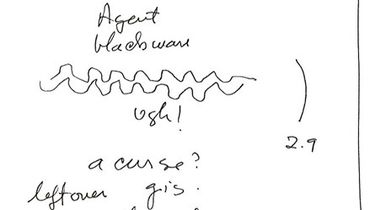
This acknowledgment points to a longstanding struggle (one that appears in both his archival notes and his later writing) what he eventually described as contact with an agent of a black war, a curse, leftover.
An Interview with William Henry Belk from Alternate Perceptions Issue #42, Spring 1998
Belk, of the Belk department store family, was the founder of the Belk Research Foundation, prior to that he was in Naval Intelligence.
"...unofficially you had gotten the word that really the conclusion I think was that it was a parallel dimension that the UFOs themselves appear to be a part of."
"...I do know that they exist because I’ve talked to people in our own government about it. They’ve been known by every president of the United States since Truman. The whole thing has been controlled by NSA – National Security Administration – at Fort Meade, Maryland. Now the CIA is under the jurisdiction of the NSA. They operate on a black budget, billions of dollars."
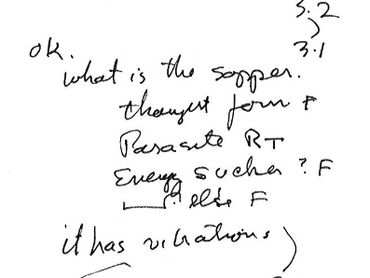
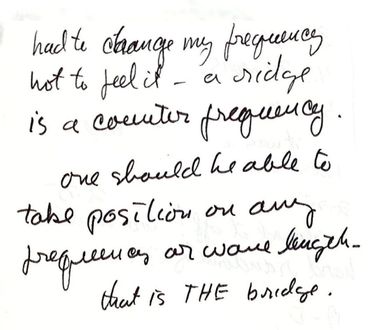
Ingo's Psychic Attack Session Notes
About Contacting Entities, Ingo had this to Say...

Contact Is Not Neutral
Ingo often spoke of human perception as something far larger than the narrow slice we use in daily life. In an unpublished passage from Pink Neon, he described what happens when awareness breaks beyond its ordinary limits:
Once you have been pierced by an angel's horn, there is no turning back. You must wear a suit of a thousand voices, adorned with nebulas, stars, and planets… A strange poetry will consume your mind and soul, raging violently through cities and planes of existence.
Ingo used imagery like this not to glamorize or mythologize attempts to expand perception for the purpose of contacting non-human or higher intelligence, but to warn that such efforts can destabilize as easily as they can illuminate. In his view, realms beyond ordinary human cognition are not empty or benevolent by default; they are crowded, symbolic, deceptive, revelatory, and often morally ambiguous.
His point was simple: these pursuits require discernment.
Attempting to connect with higher intelligence, whether through calling orbs, summoning beings, or other active contact protocols, without deep discipline, psychological containment, and intellectual sovereignty carries significant risk.
Such contact is not neutral. It is inherently asymmetric.
Once opened without sufficient preparation and restraint, these doors can profoundly reorganize one’s sense of meaning, identity, and reality in ways that are not easily reversed.
Ingo approached the expansion of human perception with disciplined respect and deliberate caution. He did not regard perceptual exploration as entertainment, casual experimentation, or a pursuit for the merely curious.
The serious study of perceptual sensing demands belief in oneself and in our extraordinary potential, supported by rigorous study, sustained practice, and intellectual discipline. There are no shortcuts to developing such capacities.
Some doors of perception lead beyond accepted human frameworks, toward intelligences, presences, and phenomena not easily understood. Once opened, such doors do not always close easily.
This is the context in which he addressed Non-Human Entities, contact, and the necessity of intellectual discipline in serious perceptual exploration, not as promises of transcendence, but as territories demanding caution, containment, and responsibility.
Remote Viewing as a Human Superpower, Not a Pathway to Contact
Ingo saw Remote Viewing as just one expression of the superpowers of the human biomind and biobody (indwelling perceptual faculties that have existed throughout human history under many names). RV, he said, was a way of “hacking” our species’ internal information network: Remote viewing is a form of virtual reality, or being wired into the Universe.
He outlined its logic succinctly:
- Psychic realms function like virtual reality.
- Both psychic and virtual systems require Entry and Access.
- Entry and Access depend on specific human faculties that already exist within our species.
- These faculties operate at different levels of consciousness.
- Spontaneous Remote Viewing is random access.
- Controlled Remote Viewing is the discovery and control of the correct wiring.
CRV is about precision, structure, and conscious regulation. It is not about communication with other intelligences.
The AI/RV Model: Why Learning RV Is Not Automatic
Ingo observed that teaching Remote Viewing was difficult for a very specific reason: people have almost no awareness of how they think or learn.
He wrote: Many strive to teach—and don’t necessarily succeed. Many strive to learn—and don’t necessarily succeed.
Most learning works well when topics are simple and concrete. But RV involves subtle perceptual processes that vary widely between individuals. As complexity increases, the gap between what is taught and what is learned widens.
The takeaway: Learning Remote Viewing is possible, but not guaranteed, because each person’s perceptual system processes information differently.
This complexity becomes even more significant when considering Contact phenomena.
The Contact/RV Model: CRV as a Safeguard, Not a Bridge
Ingo was unequivocal on one point: remote viewing requires feedback and must remain anchored in the physical world. As he put it:
A viewing cannot be said to have taken place until positive feedback indicates that it has taken place.
By defining it this way, he deliberately excluded anything that could not be verified or checked. Remote viewing, in the strict sense he created, does not include:
- Channeling
- Mediumship
- Intuitive Impressions
- Entity Communication
- Imagination
- Spontaneous Psychic Experiences
- Telepathy
- “Contact” of any kind
These may be psychic or anomalous experiences, but they are not remote viewing unless they can be confirmed against hard, physical feedback.
At the same time, some remote viewing sessions appear to evolve beyond the simple description of places, objects, or events. A session may begin with terrain, structures, or environmental conditions and later transition into what seems like a communicative or informational domain.
Whether such experiences represent actual communication, symbolic processing, informational structures, aspects of the viewer's own cognition, or something else entirely remains open to interpretation.
For Ingo, however, the distinction remained clear. The existence of unusual experiences did not automatically validate their interpretation. Remote viewing was concerned with information that could ultimately be checked against reality.
Ingo grew increasingly concerned that, outside professional or laboratory settings, the term Remote Viewing had been gradually taken over by practices that had nothing to do with the actual protocol. To him, collapsing all psychic phenomena under the Remote Viewing label didn’t just confuse the public, it erased the entire point of creating a replicable, scientific method in the first place.
Belk, Contact, and the Risks of Unregulated Perception
In a 1998 interview, (link above) researcher Belk discussed the concept of Contact: a modern term for what was historically called mediumship or “prophetic communication.” Belk described beings such as the “Council of Nine” and spoke of observable cases of possession, interference, and nonhuman influence.
Whether one accepts these claims or not, Ingo took the issue seriously.
Why Ingo Created CRV
During a 1976 self-evaluation session, Ingo experienced significant distress over the possibility of outside influences intruding into remote viewing sessions. He recognized that if perception could expand, it could also be interfered with.
To protect the perceptual channel, he created CRV as a discipline of cognitive control; a structured method specifically designed to prevent unwanted entanglement with nonhuman or unidentified intelligences.
The point cannot be overstated:
CRV was not created to facilitate Contact.
It was created to prevent Contact from intruding into the perceptual channel.
For Ingo, CRV was a tool for humans to retain autonomy, stabilize perception, and avoid psychic vulnerability in an environment where other intelligences (whatever their nature) might attempt.
The Larger Implication
Ingo believed that human beings possess profound, largely untapped perceptual capacities—capacities rooted not in external entities, but in what he sometimes called our Greater Selves. These abilities are part of our innate biological architecture. They can be strengthened, refined, and brought online through deliberate practice, study, and expanded perceptual awareness.
For Ingo, the point was never to seek guidance from outside beings. It was to activate what already exists within us.
He warned that Non-human Entities may exist, but they should never become the focus of human development. Before attempting to interpret anything external, he argued, a person must cultivate perceptual sovereignty: the ability to distinguish between genuine signal, inner noise, symbolic imagery, and the subtle influences of other consciousnesses.
This stance appears throughout his writings, but especially in Pink Neon, where he hinted that as one’s perceptual system expands and higher realms become visible, discernment becomes mandatory. Not everything that appears in the psychic landscape is wise, benevolent, or even truthful. Some impressions are symbolic, some are projections, and some may be encounters with intelligences whose motives humans cannot easily decipher.
The true work, Ingo suggested, is reclaiming the perceptual abilities humanity once relied upon: developing awareness not as passive recipients but as active participants in our own consciousness.
Was the US Government Interested in Contact and ESP?

Historical Threads
MKULTRA’s ESP Subprojects: Forced Mediumship and Dissociation
Growing Government Interest: ESP as a Security Question
It’s a reasonable question, and one we may never fully answer. But the historical record does offer hints and clues.
Across cultures and eras, humans have explored ways of communicating with nonhuman or nonphysical beings through extra-sensory means. In the West, interest expanded through Spiritualism, Mediumship, Theosophy, and later the
It’s a reasonable question, and one we may never fully answer. But the historical record does offer hints and clues.
Across cultures and eras, humans have explored ways of communicating with nonhuman or nonphysical beings through extra-sensory means. In the West, interest expanded through Spiritualism, Mediumship, Theosophy, and later the New Age movement, which brought forth both the “contactee” narrative and modern channeling.
Within Ingo’s own orbit were individuals whose work intersected these traditions. His close friend in planetary exploration, Harold Sherman, was deeply involved in the Urantia contact movement. Another figure nearby was Andrija Puharich, a U.S. Army researcher whose work with trance mediums eventually led to the famous Council of Nine sessions. These were not fringe figures; they were deeply connected, well-funded, and treated seriously by certain scientific and military circles.
Growing Government Interest: ESP as a Security Question
MKULTRA’s ESP Subprojects: Forced Mediumship and Dissociation
Growing Government Interest: ESP as a Security Question
A declassified 1977 CIA document, Psychology in Intelligence: A Personal Review and Conclusions by Kenneth Kress, makes clear that U.S. national-security agencies had been tracking reports of ESP-related abilities for decades:
Anecdotal reports of extrasensory perception (ESP) capabilities have reached the U.S. national security agencies a
A declassified 1977 CIA document, Psychology in Intelligence: A Personal Review and Conclusions by Kenneth Kress, makes clear that U.S. national-security agencies had been tracking reports of ESP-related abilities for decades:
Anecdotal reports of extrasensory perception (ESP) capabilities have reached the U.S. national security agencies at least since World War II… In 1952 the Department of Defense was lectured on the possible usefulness of ESP in psychological warfare.
That 1952 lecture (often misattributed to the Department of Defense) was actually delivered to the Pentagon Research Branch of the Office of the Chief of Psychological Warfare by Andrija Puharich.
At the time, Puharich had spent several years exploring ESP and “vibrational levels” at his Round Table Foundation, often using a Faraday Cage of his own construction with medium Eileen Garrett.
Garrett’s alleged communicator, Uvani, and later Puharich’s involvement with the Council of Nine, were of significant interest to the well-connected patrons who funded him and, eventually, to elements of the U.S. government.
The notion of different vibrational states of consciousness did not stay contained in parapsychology. It surfaced repeatedly in CIA research programs, including the most infamous of all: MKULTRA.
MKULTRA’s ESP Subprojects: Forced Mediumship and Dissociation
MKULTRA’s ESP Subprojects: Forced Mediumship and Dissociation
MKULTRA’s ESP Subprojects: Forced Mediumship and Dissociation
MKULTRA’s goal was to develop chemical, biological, and radiological methods for controlling human behavior, methods that often drifted into coercive or unethical territory. Out of 149 known subprojects, two concerned ESP specifically: Subprojects 83 and 136.
Although heavily redacted, surviving documents reveal striking details. Subproje
MKULTRA’s goal was to develop chemical, biological, and radiological methods for controlling human behavior, methods that often drifted into coercive or unethical territory. Out of 149 known subprojects, two concerned ESP specifically: Subprojects 83 and 136.
Although heavily redacted, surviving documents reveal striking details. Subproject 136, building on Subproject 83, focused on:
- dissociative states;
- hypnosis and drug-induced trance;
- the induction of mediumistic or trance-channeling conditions;
- “qualitative stimuli” such as symbolic imagery and emotional associations; and
- tailoring tasks to manipulate the subject’s mental state.
A key passage from the declassified proposal states:
Special attention will be given to dissociative states, which tend to accompany spontaneous ESP experiences… In other cases, drugs and psychological tricks will be used to modify [the subject’s] attitudes… An attempt will be made to induce a number of states of this kind, using hypnosis.
In plain terms:
The goal appears to have been the deliberate creation of a mediumistic state (forced channeling) through drugs, hypnosis, sleep disruption, and extreme psychological pressure.
The question becomes unavoidable:
Why would a military intelligence program want to force people into trance communication, and with whom did they believe contact might occur?
Who Ran the ESP Subprojects? A Telling Clue
The Air Force, Project Blue Book, and Interdimensional Theories
The Air Force, Project Blue Book, and Interdimensional Theories
By comparing shared language, methodology, and goals between Subproject 136’s proposal and a 1963 unclassified study titled “Testing for Extrasensory Perception With a Machine”, the likely contractor emerges:
Cambridge Research Laboratories, Office of Aerospace Research, United States Air Force.
This was the Air Force’s premier laboratory
By comparing shared language, methodology, and goals between Subproject 136’s proposal and a 1963 unclassified study titled “Testing for Extrasensory Perception With a Machine”, the likely contractor emerges:
Cambridge Research Laboratories, Office of Aerospace Research, United States Air Force.
This was the Air Force’s premier laboratory for high-altitude technology, electronic signals, and advanced communications.
In other words, the same Air Force deeply entangled in the UFO problem during the early 1960s, precisely when Subproject 136 was active.
The Air Force, Project Blue Book, and Interdimensional Theories
The Air Force, Project Blue Book, and Interdimensional Theories
The Air Force, Project Blue Book, and Interdimensional Theories
During Subproject 136’s peak years (1961–1962), the Air Force was overwhelmed by UFO reports under Project Blue Book.
Blue Book was closed in 1969 with the public conclusion that UFOs did not represent extraterrestrial craft. But skeptics noted that the phrasing left room for interpretation:
not extraterrestrial does not necessarily mea
During Subproject 136’s peak years (1961–1962), the Air Force was overwhelmed by UFO reports under Project Blue Book.
Blue Book was closed in 1969 with the public conclusion that UFOs did not represent extraterrestrial craft. But skeptics noted that the phrasing left room for interpretation:
not extraterrestrial does not necessarily mean not real.
Dr. J. Allen Hynek, Blue Book’s scientific consultant, later proposed that UFOs and their occupants might be interdimensional, manifesting from another vibrational or dimensional level rather than arriving from distant planets.
This mirrors the very kinds of “vibrational level” concepts that Puharich introduced to Pentagon audiences in the early 1950s.
Ingo’s Own Perspective
The Air Force, Project Blue Book, and Interdimensional Theories
Ingo’s Own Perspective
Ingo himself pointed toward this possibility early on. In a April 1973 Psychic Magazine article, he said:
We have to establish greater senses in order to establish a reality for these things that exist at other places.
By “other places,” Ingo did not mean distant planets.
He meant other levels of reality, other vibrational states, other d
Ingo himself pointed toward this possibility early on. In a April 1973 Psychic Magazine article, he said:
We have to establish greater senses in order to establish a reality for these things that exist at other places.
By “other places,” Ingo did not mean distant planets.
He meant other levels of reality, other vibrational states, other dimensions, perhaps realms where nonhuman intelligences might operate.